Different Instruction Cycles
The concept of instruction cycles is integral to understanding how a computer's central processing unit (CPU) executes instructions. Here's an explanation of each of these cycles:
Fetch Cycle
-
Description: The fetch cycle is the initial stage of the instruction cycle. It involves retrieving the next instruction from memory.
-
Operation: The CPU uses the program counter (PC) to access the memory location where the next instruction is stored. The instruction is fetched and placed in the instruction register (IR).
-
Purpose: This cycle ensures that the CPU has the next instruction ready for decoding and execution.
Indirect Cycle
-
Description: The indirect cycle is sometimes required when instructions involve accessing memory locations that contain addresses or pointers to the actual data.
-
Operation: During this cycle, the CPU may use an address obtained from the previous instruction to access another memory location, which holds the data or another address to be used in the next cycle.
-
Purpose: The indirect cycle enables the CPU to follow memory references and retrieve the actual data required for execution.
Execute Cycle
-
Description: The execute cycle is where the central processing unit performs the operation specified by the decoded instruction.
-
Operation: The CPU carries out arithmetic computations, logical operations, data transfers, or any other actions as dictated by the instruction. This may involve accessing data from registers or memory, performing calculations, and updating registers or memory locations.
-
Purpose: The execution stage accomplishes the intended operation and is where the actual work of the instruction takes place.
Interrupt Cycle
-
Description: The interrupt cycle comes into play when an external event or condition triggers an interrupt, causing the CPU to temporarily suspend its current execution to handle the interrupt request.
-
Operation: The CPU saves its current state (program counter and other relevant information) before jumping to an interrupt service routine (ISR). After servicing the interrupt, the CPU may restore its state and continue execution.
-
Purpose: Interrupt cycles enable a CPU to respond to external events or asynchronous inputs promptly without losing important data or program context.
Uses of Different Instruction Cycles
The different instruction cycles (fetch, indirect, execute, and interrupt) in a computer's operation have different purposes and applications, ensuring efficient and responsive processing. Here are the uses of each instruction cycle:
Fetch Cycle
-
Use: Retrieving the next instruction from memory.
-
Application: Essential for the sequential execution of program instructions, ensuring the CPU has the next instruction ready for decoding and execution.
-
Example: Fetching the opcode of the next instruction from memory to be decoded and executed.
Indirect Cycle
-
Use: Handling instructions that involve accessing memory locations containing addresses or pointers.
-
Application: Facilitates memory referencing, allowing the CPU to navigate through multiple levels of indirection to access the actual data or instructions.
-
Example: Accessing data through a memory location that contains a pointer to the actual data's location.
Execute Cycle
-
Use: Performing the operation specified by the decoded instruction.
-
Application: Where the actual computation or data manipulation occurs, making it the heart of instruction execution.
-
Example: Carrying out arithmetic calculations, logical operations, data transfers, or any actions dictated by the instruction.
Interrupt Cycle
-
Use: Handling external events or requests for interrupting the CPU's current execution.
-
Application: Ensures prompt response to hardware or software events such as hardware interrupts, system calls, or exceptions, allowing the CPU to temporarily switch tasks.
-
Example: Responding to a keyboard input interrupt, saving the CPU's current state, and invoking an interrupt service routine (ISR).
Why do we Need an Instruction Cycle?
- The instruction cycle of a computer system is necessary for understanding the flow of instructions and the execution of an instruction in a computer processor.
- It is responsible for the complete flow of instructions from the start of the computer system through its shutdown. The instruction cycle helps to understand the internal flow of the central processing unit, allowing any faults to be immediately resolved.
- It deals with a computer processor's basic operations and demands a detailed understanding of the many steps involved.
-
All instructions for the computer processor system follow the fetch-decode-execute cycle.
Also read, microprogrammed control unit
Importance of Instruction Cycle
- The instructions are the basic activities conducted in the main memory of the central processing unit. That is why they are so crucial to the processor system.
- It's a set of stages that helps us to understand how instruction flows. The instruction cycle allows the computer processor to see the sequence of instructions from start to finish.
- It is common for all instruction sets to require a thorough understanding to perform all operations efficiently.
- The processing time of a programme can be easily calculated using the instruction cycle, which aids in determining the processor's speed.
- The processor's speed determines how many instructions can be executed simultaneously in the central processing unit.
Advantages of Instruction Cycle
-
Efficiency: The fetch-decode-execute cycle, consisting of instruction cycles, allows CPUs to execute instructions sequentially and efficiently, ensuring that each instruction is processed in a well-defined manner.
-
Flexibility: CPUs can handle a wide range of instructions, from arithmetic operations to data transfers, by following the execution cycle for each instruction type.
-
Control Flow: The instruction cycle controls the flow of program execution, advancing to the next instruction after each cycle, allowing for precise execution and program control.
-
Responsiveness: CPUs can quickly respond to external events and handle interrupts or exceptions using the interrupt cycle, making them versatile and suitable for various tasks.
Disadvantages of Instruction Cycle
-
Clock Speed: The speed of instruction execution is often constrained by the system's clock speed, limiting the number of instructions that can be executed in a given time period.
-
Pipeline Stalls: In pipelined architectures, where multiple instructions are processed simultaneously, issues like pipeline stalls can lead to inefficiencies if instructions depend on one another.
-
Resource Limitations: CPU execution is subject to resource limitations, such as the availability of registers, memory access times, and cache sizes, which can affect performance.
-
Instruction Set Limitations: CPUs are limited by their instruction set architectures (ISAs), which may not include certain specialized instructions or features required for specific applications.
-
Complexity: The fetch-decode-execute cycle is an intricate process, and the complexity of instruction execution can lead to design challenges and potential errors in the processor's microarchitecture.
Recommended Topic - Memory hierarchy in computer network
Frequently Asked Questions
What is the Instruction cycle?
The instruction cycle is defined as the basic cycle in which a computer system fetches an instruction from memory, decodes it, and then executes it.
What is five stage instruction cycle?
The five-stage instruction cycle, or pipeline, is a CPU processing model consisting of five stages: fetch, decode, execute, memory, and write-back. It enhances CPU efficiency by parallelizing instruction processing.
Why is instruction cycle important?
The instruction cycle is essential as it defines how a CPU processes and executes instructions in a structured and controlled manner, ensuring accurate and efficient program execution.
What are the steps of the instructional cycle?
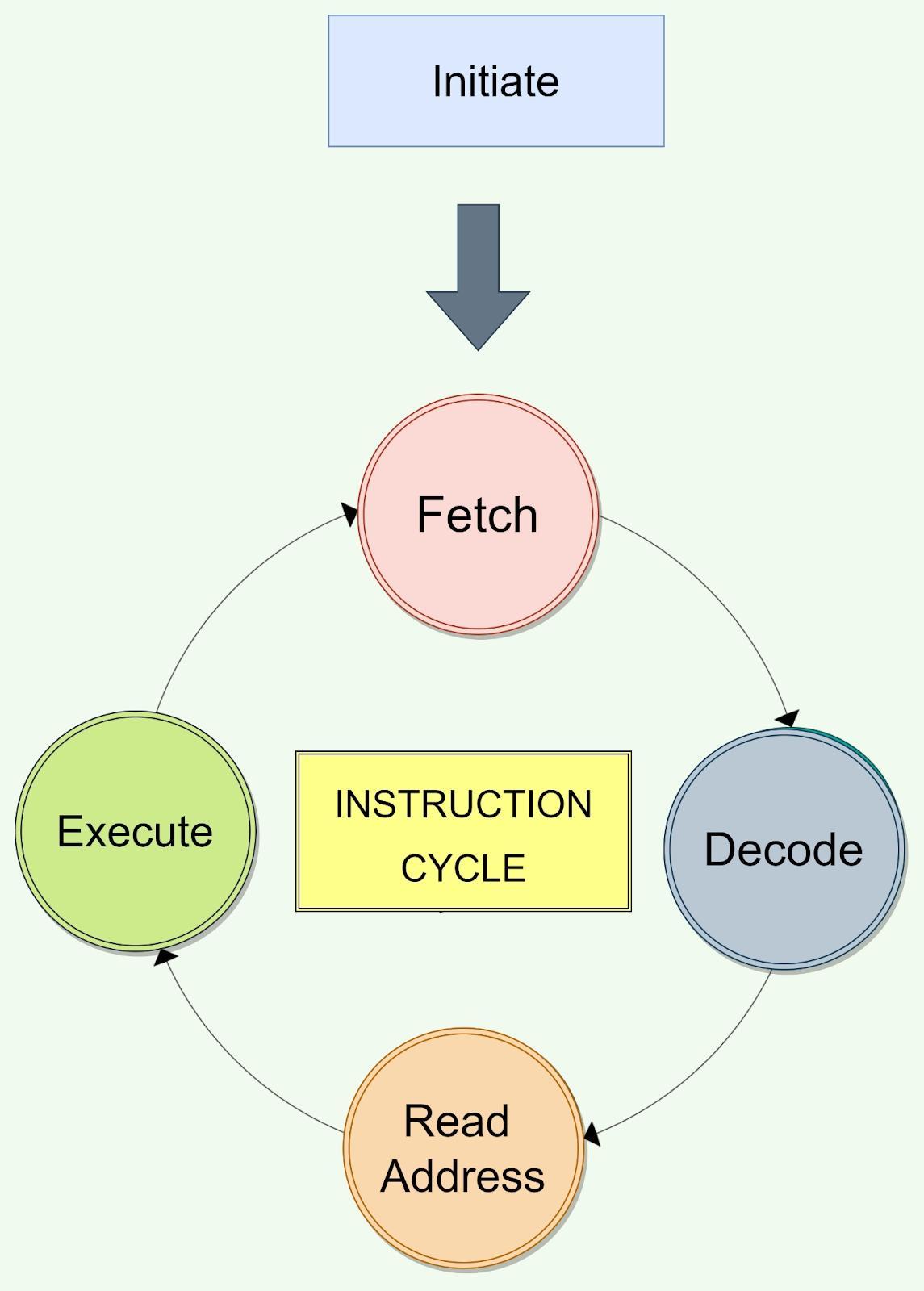
The steps involve in the instructional cycle are Initiating Cycle, fetching the instruction i.e CPU sends PC to MAR and then reads the instruction. The next is to decode the instructions. In this CPU determines which instruction should be fetched and its action. It includes decoding and reading an effective address. The last step is the execution of the instruction.
What is the instruction cycle and machine cycle?
The instruction cycle and the machine cycle are both the process of computer architecture. These are involved in the execution of instructions by a CPU. In the instruction cycle, it follows a series of steps to execute the instruction whereas in the machine cycle, it is composed of several sub-cycles which depend on the CPU architecture.
Conclusion
In this blog, we have thoroughly discussed on Instruction Cycle in Computer Architecture. We also learned about different instruction cycles, the uses of different instruction cycles, their needs, and their importance. Later in the end we discussed the advantages and disadvantages of the instruction Cycle in Computer Architecture.
If you're interested in learning advanced front-end web development, Coding Ninjas has one of the best courses on the internet, which you can find here.
Recommended Reading:
MVVM Architecture Android
Click here to know more about What Is a Motherboard here.
Recommended Reading:
Free Space Management in OS







 7+ registered

