

Table of contents
1.
Introduction
2.
Spooling in OS
2.1.
How Spooling works
3.
Buffering in OS
3.1.
Why is Buffering used?
4.
Difference between Spooling and Buffering
5.
Frequently Asked Questions
5.1.
Which type of memory is used in spooling to hold data?
5.2.
Which type of memory is used in spooling to hold data?
6.
Conclusion
Last Updated: Mar 27, 2024

Difference between Spooling and Buffering

Author Jainish Patel
0 upvote
Career growth poll
Do you think IIT Guwahati certified course can help you in your career?
Operating Systems

Introduction

As you know, computers when first introduced are too bulky, and with that, it takes too much time to perform small tasks like addition or any mathematical calculation. But with time and improvements, the computer becomes super fast. The one reason for being slow is they perform 1 task at a time, like taking an input is a task, processing the instruction is another task and showing the output of the result is the final task. But while taking input, the CPU becomes idle, so it cannot perform tasks because I/O (input or output) operations are resource-intensive tasks. To solve this dilemma Spooling and Buffering was introduced in the Also see, Operating System so that the CPU utilization increases. 

In this article, we will study the concept of Spooling and buffering and the differences between them.

Let first get some idea of the concept of spooling and Buffering before looking at the difference between them.

Also read, Multiprogramming vs Multitasking And Open Source Operating System

Spooling in OS

Spooling is the process of temporarily storing data to be used and processed by a device, program, or system. Data is sent to and held in memory or other volatile storage until it is requested for execution by a program or computer.

SPOOL stands for simultaneous peripheral operations online. The spool is usually kept in the computer's physical memory, buffers, or interrupts for I/O devices. The FIFO (first-in, first-out) method is used to process the spool in ascending order.

How Spooling works

Spooling works in the following steps:

  • Spooling is the process of creating a buffer called SPOOL that is used to hold tasks and data until the device that generated the SPOOL is ready to use and execute the job or perform data operations.
  • Any secondary memory coupled to a faster device is used as a SPOOL buffer when it delivers data to a slower device to complete some action. This information is stored in the SPOOL until the slower device is ready to process it. The data in the SPOOL is loaded into the main memory for the appropriate operations once the slower device is ready.
  • Spooling treats the entire secondary memory as a massive buffer that may hold a large number of jobs and data for a variety of activities. Spooling has the advantage of being able to build a queue of jobs that execute in FIFO order, one by one.
  • A device can connect to a large number of input devices, each of which may require some data processing. As a result, all of these input devices can write their data to the secondary memory (SPOOL), which the device can subsequently process one by one. This will prevent the CPU from becoming idle at any moment. Spooling can thus be described as a hybrid of buffering and queuing.
  • The output of the CPU is first saved in the main memory after it is generated. This output is moved from the main memory to the secondary memory, where it is transmitted to the appropriate output devices.
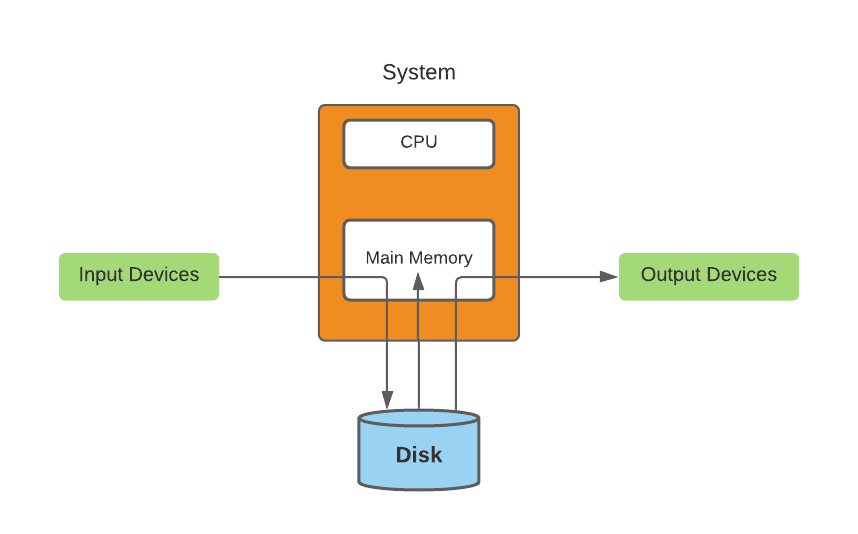
 

Spooling in OS

Example of Spooling

Printing is the most obvious example of spooling. The papers to be printed are stored in the SPOOL before being added to the printing queue. During this time, several programs can run and utilize the CPU without having to wait for the printer to complete the printing process on each paper individual

Examples of Spooling

Buffering in OS

The buffer is a section of main memory used to store or hold data temporarily. In other words, a buffer holds data that is sent from one location to another, such as between two devices or an application. Buffering is the process of temporarily storing data in a buffer.

When moving data between processes on a computer, a buffer may be employed. Buffers can be implemented in hardware as a fixed memory location or in software as a virtual data buffer pointing to a physical memory address. The data in a data buffer is always saved on a physical storage device.

The majority of buffers are implemented in software, and because RAM has a significantly faster access time than hard disc drives, it is often used to store temporary data. Buffers are commonly employed when there is a disparity between the rate at which data is received and the rate at which it is processed, such as in a printer spooler or online video streaming.

A buffer often adjusts timing by implementing a queue or FIFO mechanism in memory, simultaneously writing and reading data into the queue at different rates.

Buffering in OS

Why is Buffering used?

Whenever you watch videos on any platform like youtube, Netflix, or any online streaming platform, you may experience buffering on video because of low internet speed. This happens because the amount of download speed required is not sufficient to play the video in real-time.

A buffer is required to function as a temporary placeholder for everything interacting on a computer because many distinct devices work at various speeds. This is done to ensure that everything runs smoothly and without errors between all of the devices, programs, and processes that are active at the time. There are three reasons for data buffering.

  1. It helps in the matching of data transmission speeds between two devices.
  2. It helps devices with varying data transfer sizes in adapting to one another. It assists devices in manipulating data before transmitting or receiving it.
  3. Copy semantics are also supported. The version of data in the buffer guaranteed by copy semantics is the version of data in the buffer at the time of the system call, regardless of any subsequent changes to data in the buffer. Buffering improves the device's performance. It combines the input/output (I/O) of one job with the computation of another.

    You can also read about the Multilevel Queue Scheduling.

Difference between Spooling and Buffering

Spooling v/s Buffering

Difference Between Rank and Dense Rank

Frequently Asked Questions

Which type of memory is used in spooling to hold data?

Volatile memory or Hard disk is used to store temporary data.

Which type of memory is used in spooling to hold data?

Primary memory or RAM is used to store temporary data.

Conclusion

This article discusses the concept of spooling, the concept of buffering, and also the difference between them.

Recommended Reading:

Do check out The Interview guide for Product Based Companies as well as some of the Popular Interview Problems from Top companies like Amazon, Adobe, Google, Uber, Microsoft, etc. on Coding Ninjas Studio.

Also check out some of the Guided Paths on topics such as Data Structure and Algorithms, Competitive Programming, Operating Systems, Computer Networks, DBMS, System Design, etc. as well as some Contests, Test Series, Interview Bundles, and some Interview Experiences curated by top Industry Experts only on Coding Ninjas Studio.

Cheers!

Live masterclass


