




Introduction📝
This article will discuss How to deploy Python WSGI Applications using a CherryPy.
But before discussing How to Deploy Python WSGI Applications Using a CherryPy, let's understand the CherryPy and CherryPy WSGI web servers.
CherryPy is a minimalist Python Web Framework. Here, Minimalism is refraining from imposing things on the developers without giving them a choice.
CherryPy is a pure Python web server with a compact solution with the namesake framework. It is defined by the [CherryPy] project as a high-speed, production-ready, thread pooled, generic HTTP server. It is a modularized component that can be used to serve any Python WSGI web application.
Following are the CherryPy Web Server's Highlights:
- It is very compact and straightforward to use a pure-Python solution.
- It is easy to configure.
- It is thread-pooled and fast.
- It allows scaling
- It Supports Secure Socket Layer

We always have been eager to know why before how? So, before knowing How to Deploy Python WSGI Applications Using a CherryPy, Let's discuss why we deploy with CherryPy’s WSGI web server.
Why do we deploy With CherryPy's WSGI Web Server?👀
We use CherryPy's WSGI web server due to the excellent specification of WSGI, which has been relatively easy to create a web server. But over the years, it gave birth to many of them, some reaching a certain level of popularity and most remaining hidden inside their developer's machine.
The number of choices is vast, and they mostly do the same thing under-the-hood to a large extent.

Until now, one thing is unclear: Why exactly should we use the CherryPy web server for our application's deployment?
So, let's discuss this.
We use the CherryPy web server for our web application deployment because it is easy to use to serve our WSGI web application. It will save tons of headaches as we get up and running within a minute or two. It is customizable to a certain degree, allowing us to run multi-process and multi-threaded instances in the effortless way possible through a single file.
CherryPy Web Server is a proper rock-solid way to serve Python WSGI-based web applications coupled with ease by using Nginx as a front-facing reverse proxy.
Why do we use Nginx as Reverse-Proxy In Front of CherryPy?👁️🗨️
Nginx is a very high-performant web server that has reached popularity due to being lightweight, relatively easy to work with, and easy to expand (with add-ons/plug-ins).
Also, the architecture plays an essential role as it can handle many requests depending on our application or website load.
Now, let's discuss Why we should use Nginx as a reverse proxy in front of an application server.
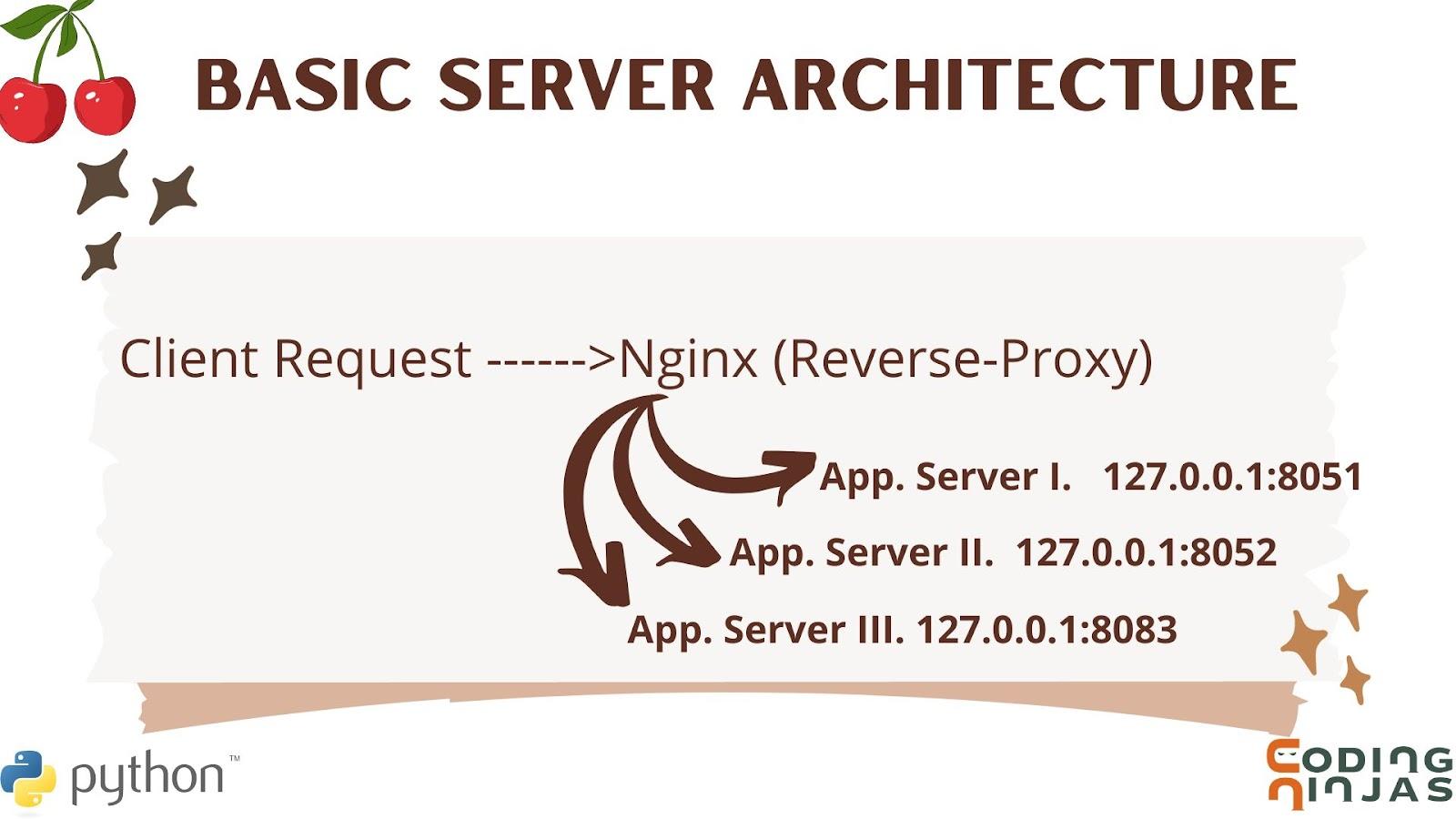
Although CherryPy WSGI web server in our case can serve our application and its static files (e.g., javascript, css, images, etc.), therefore it is an excellent idea to use a reverse-proxy set up in front, such as Nginx. Because this relieves a lot of the load from the application servers as it handles the client requests and various other tasks, granting you a much better overall performance.
As our application grows, we will want to optimize it. When the time comes, we will distribute it across servers to handle more connections simultaneously and have a more robust architecture. A reverse proxy helps us with this from the beginning in front of our application server.
Its extensibility is also a remarkable feat that benefits web applications, unlike simple application servers.
Example of basic server architecture.🖼️
Serving Python Web Applications with CherryPy Web Server🐍
This section will discuss how a WSGI application works with the CherryPy web server. It consists of providing the server with a WSGI application callable (e.g., application = (..)) as the point of entry.
WSGI
WSGI is an interface between the web server and the application itself. It ensures a standardized way between servers and applications (frameworks) to work with each other, allowing interchangeability when necessary.
We have briefly discussed the topic “How to Deploy Python WSGI Applications Using a CherryPy.” If you have any questions, you can refer to this link to learn more about How to Deploy Python WSGI Applications Using a CherryPy, which we have already discussed.
Let's discuss FAQs related to How to Deploy Python WSGI Applications Using a CherryPy.
Frequently Asked Questions🧑💻
Is Django a WSGI?
The primary deployment platform of Django is WSGI, the Python standard for web servers and applications. The startproject management command of Django sets up a minimal default WSGI configuration for us, which we can tweak as needed for our project and direct any WSGI-compliant application server.
Is Flask a WSGI?
Yes, Flask is a WSGI application. The WSGI server is used to run the application, converting incoming HTTP requests to the standard WSGI environment and converting outgoing WSGI responses to HTTP responses.
What do you mean by WSGI?
WSGI stands for Web Server Gateway Interface. It handles requests synchronously. When requests come in, they are processed sequentially or one after the other, and because of that, they have to wait until the one before it finishes before switching to a new task.
What do you mean by ASGI?
ASGI stands for Asynchronous Server Gateway interface. ASGI processes requests asynchronously, in the opposite way as WSGI. When requests are processed asynchronously, the beauty is that they don't have to wait for the others before them to finish doing their tasks.


 7+ registered

