Do you think IIT Guwahati certified course can help you in your career?
Introduction
Database Management System (DBMS) is a software that helps to manage large amounts of data efficiently. DBMS helps to organize database files and gives users more control over their data.
In this article, we will learn about the structure of DBMS and its main components in detail by discussing their features and functions. But first, we need to dig a little deeper and understand what a Database Management System is.
What is a Database Management System?
As was already said, DBMS is software created to manage massive volumes of data efficiently. A DBMS is a valuable tool for effectively handling vast amounts of data and giving users more control over their databases. Three major components make up a DBMS.
Query Manager - The query manager has three jobs to perform. It runs user queries, gets data from the memory manager and shows the result to the user.
Storage Manager - The storage manager controls the data's physical storage. The Storage Manager performs CRUD (Create, Read, Update, Delete) operations.
Disk Storage - The data is saved efficiently and safely even after the system shutdown in the disk storage.
DBMS is a crucial tool for effectively handling massive volumes of data. When many people use the same data, it helps to manage, share, and maintain data integrity. DBMS also helps to get rid of data errors and inconsistencies by making sure the data is real. DBMS also protects sensitive data by ensuring only authorized individuals can access it.
We will go through the structure of DBMS and the key characteristics of its parts in the next section.
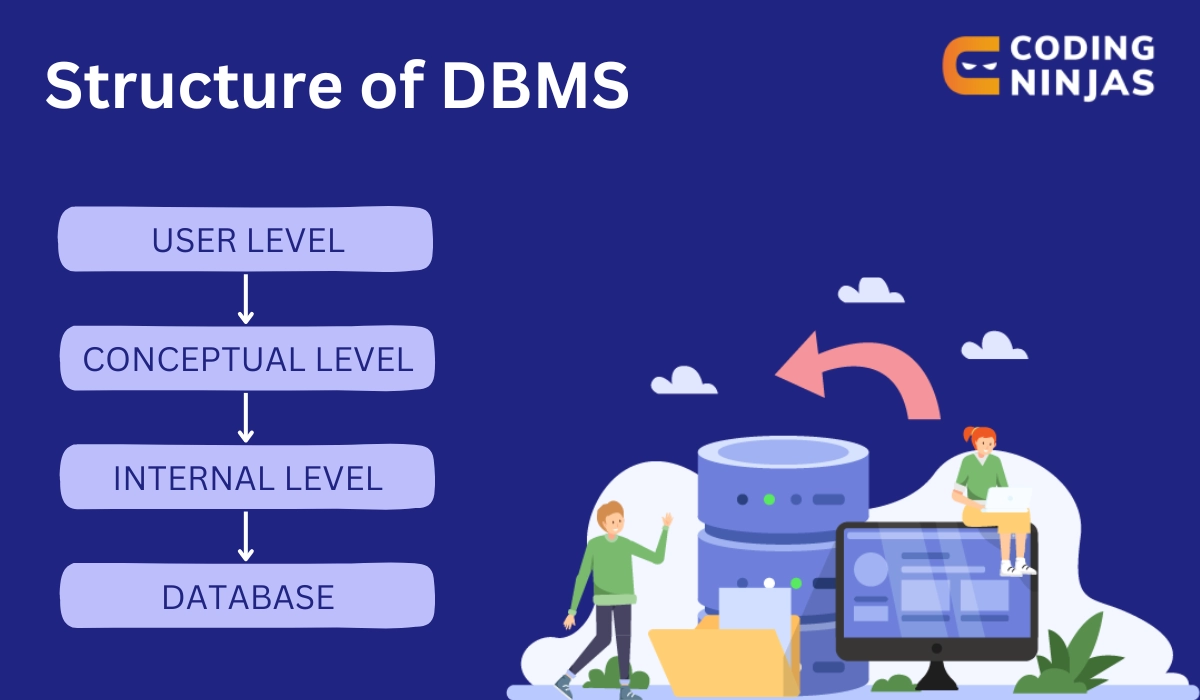
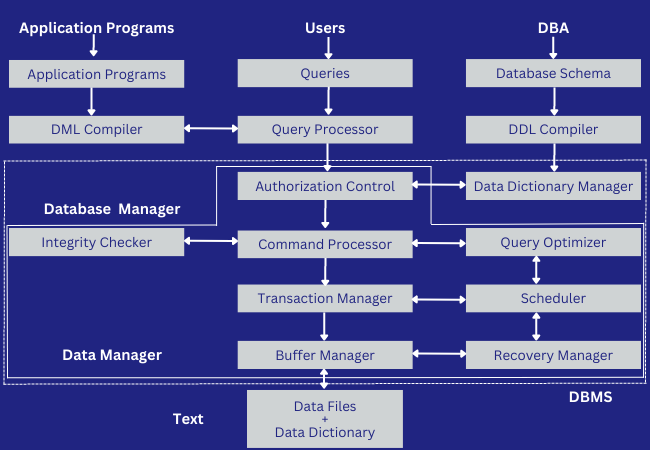
As we have discussed above, the structure of DBMS is divided into three main components. In this section, we will discuss each of these components in detail.
1. Query Processor
The primary role of the Query Processor is to interpret and execute queries given by the user. When a user or an application sends a question to the DBMS, the query manager first translates that query into a low-level language, which the storage manager understands. The storage manager then processes the query and provides the data the user or the application requires. The Query Processor then sends this data back to the user.
Components of the Query Processor
The query processor has the following components.
DDL Interpreter - DDL stands for Data Definition Language. The DDL interpreter changes the DDL statements into a specific format to make sense to the storage manager. The DDL also ensures the consistency and validity of the database.
DML Compiler - DML stands for Data manipulation language . The DML compiler changes DML commands like SELECT, INSERT, and DELETE into low-level instructions so the storage manager can understand them. The DML compiler also optimizes the queries to guarantee faster execution.
Embedded DML Pre-compiler - The Embedded DML pre-compiler processes the DML commands and precompiles them into standard procedural calls, which can be executed within the host programming language.
Query optimizer - This system component processes the SQL queries and determines the most efficient execution plan for the queries. The query optimizer considers all the possible ways to process a query. It then chooses the most optimal route among them. The query optimizer helps reduce the execution time and the resources required for a query. It also helps in providing a faster response to users.
2. Storage Manager
The storage manager is the part of the Database management system responsible for controlling the data storage in the database. The storage manager's main job is to handle the secondary storage's storage. It also allows retrieval of data to offer access to the database.
The storage manager is responsible for creating, reading, updating, and deleting data in the database. It also ensures that the database maintains its consistency and integrity by denying any unauthorized access.
Components of Storage Manager
The storage manager's main components are listed below.
File Manager - The file manager is responsible for creating, opening, and removing files in the database.
Access Manager - The access manager controls user access to databases and ensures no one is given unlawful access.
Transaction Manager - The transaction manager is responsible for ensuring the consistency of the transactions. It also checks modifications in the database and allows recovery of data.
Disk Space Manager - The DSM controls the allocation and deallocation of disc space and constantly informs if the space is available.
Buffer Manager - The Buffer Manager performs memory caching to give faster access to frequently used data.
3. Disk Storage
Disk Storage refers to physical storage devices like hard disks, which are used to store data. Disk storage provides a medium for storing data that remains stored even after the system is shut down.
Components of Disk Storage
The Disk storage has mainly three components.
Data Dictionary - This database component provides metadata about the data components. These components include tables, relations, and columns with their names, descriptions, constraints, etc.
Data Files - Data files are physical units of storage that store the data in a file systematically. These are stored on hard drives, solid-state drives, etc.
Indices - In a database management system, indices are a type of Data Structure to provide fast access to data based on specific columns of a table. This help finds particular data entry rows which match the given search criteria.
The disk storage is optimized for storing data efficiently. It also ensures fast retrieval to user queries. The disk storage applies various techniques like partitioning, caching, indexing, data compression, etc. to ensure these optimizations.
Difference between DBMS Structure and DBMS Architecture
S.No.
DBMS Structure
DBMS Architecture
1
It is the process of developing a structured database plan. This includes deciding what data will be stored in the database, how it will be arranged, and how different data pieces will be related to one another.
It refers to the entire structure of a database system, which includes the hardware and software components as well as how they interact with one another.
2
The goal of database design is to create a structure that is both efficient and effective in meeting the needs of the users of the database.
It is concerned with the overall design of the system, including the hardware and software infrastructure, the data storage and retrieval mechanisms, and the overall system performance and scalability.
3
DBMS structure Ensures data integrity through constraints.
DBMS Architecture deals with communication and system interactions.
4
It Specifies permissions and security features.
It addresses scalability, performance, and design
5
It ensures that multiple users or transactions can access and modify data simultaneously without conflicts.
It manages concurrent access through techniques like locking, timestamp ordering, and transaction isolation levels to maintain data consistency.
The structure of a DBMS typically includes a database schema, which defines tables, their attributes, and relationships. It also includes data storage, query processing, and transaction management components for efficient data management.
What are the 3 layer structure of DBMS?
The three-layer structure of DBMS includes:
External or View Layer: Provides different views of data to users.
Conceptual or Logical Layer: Defines the logical structure of the entire database.
Internal or Physical Layer: Describes how data is stored and accessed physically on storage devices.
What are the 4 types of database structures?
The four types of database structures are:
Hierarchical: Organizes data in a tree-like structure.
Network: Extends hierarchical model with more flexibility in relationships.
Relational: Organizes data into tables with rows and columns.
Object-Oriented: Stores data as objects with attributes and methods.
What is a structure in database?
In a database context, structure refers to the way data is organized and stored, defining tables, relationships, keys, and constraints to ensure data integrity and efficient retrieval.
What is storage structure in DBMS?
Storage structure in DBMS refers to how data is physically organized and stored on storage devices like disks. It involves techniques such as indexing, clustering, and partitioning to optimize data access and retrieval performance.
Conclusion
In this article, we discussed the structure of DBMS and the critical components of a database management system, including the query manager, storage manager, and disk storage. We also discussed some techniques that the DBMS uses to optimize the queries. So now that you have learned about the structure of DBMS, you can also refer to other similar articles.






 9+ registered

