Do you think IIT Guwahati certified course can help you in your career?
Introduction
We can classify our computer system based on Instruction sets in two types: RISC and CISC. So in this article, we will discuss RISC Pipeline. RISC is elaborate as Reduced Instruction Set Computers. It is a microprocessor designed to perform a smaller number of computer instructions so it can operate at a fast speed as one Instruction per clock cycle.
The main motive behind this RISC pipeline is to simplify hardware by using an instruction set composed of basic steps for evaluating, loading, and storing operations. So let’s see about RISC Pipeline in the below sections.
The pipeline is a set of data processing elements connected in series, where the output of one data processing element is input to a new element. Elements of the pipeline are often executed in a parallel or time-sliced fashion.
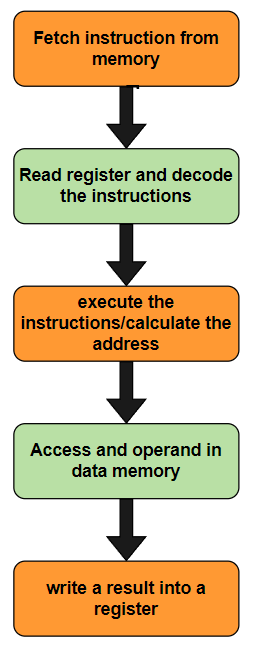
Here we are mainly concerned about the instruction pipeline that allows the execution of multiple instructions with the same circuitry. This circuitry is divided into stages, and each stage process one Instruction at a time. These stages are
1. Instruction fetch (IF): The processor reads the next Instruction to be executed.
2. Instruction decode (ID): Processor works out what this Instruction is.
3. Operand fetch (OF): Processor reads values required by the operation.
4. Instruction execution (EX): The processor executes Instruction on operand values.
5. Result storage (WB): Processor stores the result of the operation in the register/memory.
RISC
🎯Reduced Instruction Set Computer is a special kind of Instruction Set Architecture with attributes with lower cycles per Instruction (CPI) than CISC.
🎯RISC is a load/ store architecture as memory is only accessed through specific instructions rather than as a part of most instructions.
🎯RISC architecture is widely used across various platforms, from cellular telephones to the fastest supercomputer.
RISC Pipeline🕵️♀️
Pipelining, a (standard feature in RISC processors) is like an assembly line. Because the processor function on different steps of the Instruction at the same time, more instructions can be operated/executed in a short time. Several steps vary in different processors, but that steps are generally variations of these five:
Pipelining is used to improve overall performance.
Features of the RISC pipeline
RISC pipeline can use many registers to decrease the processor memory traffic and enhance operand referencing.
It keeps the most frequently accessed operands in the CPU registers.
In the RISC pipeline, simplified instructions are used, leaving complex instructions.
Here register to memory operations is reduced.
Instructions take a single clock cycle to get executed.
Example📖
Let’s consider Instruction in the circumstances related to RISC architecture. In RISC machines, registering is most of the operations. Therefore, the instructions can be performed in two phases:
✍️ E: Execute Instruction on register operands and keep/store the results in the register.
✍️ F: Instruction Fetch to get the Instruction.
Generally, the memory access in RISC is performed through STORE and LOAD operations. For these types of instructions, the following steps are required:
✍️ F: Fetch instructions to get the Instruction
✍️ E: Effective address calculation for the required memory operand
✍️ D: register-to-memory or memory-to-register data transfer through the bus.
Note that the above pipeline is not running at its total capacity.
Principles of RISC Pipeline📙
There are numerous principles of the RISCs pipeline, which are as follows:
📝 Keep the operands that are frequently accessed in CPU registers.
📝 It can reduce register-to-memory operations.
📝 It can use a more significant number of registers to improve operand referencing and reduce the processor memory traffic.
📝 It can enhance the design of instruction pipelines so that minimum compiler code generation can be achieved.
📝 It can use a simple instruction set and eliminate unnecessary and complex instructions.
Let’s consider a three-segment instruction pipeline that displays how a compiler can enhance the machine language program to compensate for pipeline conflicts.
The three types of frequent collection of instructions for a RISC processor are as follows:
Data Transfer Instructions
These instructions store and load instructions that use a fruitful address acquired by adding the content of 2 registers or a register and a displacement constant provided in the Instruction.
Data Manipulation Instructions
These instructions manage the data in the processor register.
Program Control Instructions
These instructions use a constant and a register value to evaluate the branch address, which is transferred to the program counter or a register.
Importance of RISC🙇
The importance of RISC processors is as follows:
Register-based execution
Fixed Length instruction and Fixed Instruction Format
Some of the advantages of RISC processors are as follows:
🧿 This RISC architecture allows developers the freedom to make use of the space on the microprocessor.
🧿 RISC allows high-level language compilers to generate efficient code due to the architecture having a set of instructions.
🧿 RISC processors utilize only a few parameters; besides, RICS processors cannot call instructions; hence, it uses fixed-length instructions that are easy to pipeline.
🧿 RISC reduces the execution time while increasing the overall operation speed and efficiency.
🧿 RISC is relatively simple because it has very few instruction formats; also, a small number of instructions and a small number of addressing modes are needed.
RISC pipeline is better because RISC instructions are less and simpler than those used in pre-RISC processors(known as CISC).
What is the disadvantage of RISC?
The disadvantage of RISC is that the RISC processor spends much time waiting for the first instruction result before proceeding with the next Instruction.
What is RISC Pipeline in computer architecture?
RISC in computer architecture stands for Reduced Instruction Set Computers. The RISC pipeline is used to simplify the design of computer architecture.
What are the examples of RISC processors?
Examples of RISC processors are the Microchip PIC processors, MIPS, Atmel’s AVR, PowerPC, Arm processors, and all recent modern microprocessors.
What is the purpose of pipelining?
Pipelining keeps all portions of the processor engaged and maximizes the amount of useful work the processor can do in a given time.
Conclusion
In this article, we have discussed RISC Pipeline in detail. We introduced RISC and the RISC pipeline, then saw examples, principles of the RISC PIpeline, the Importance of RISC, and the Advantages of RISC.







 7+ registered

